sotto
How sotto works: a course
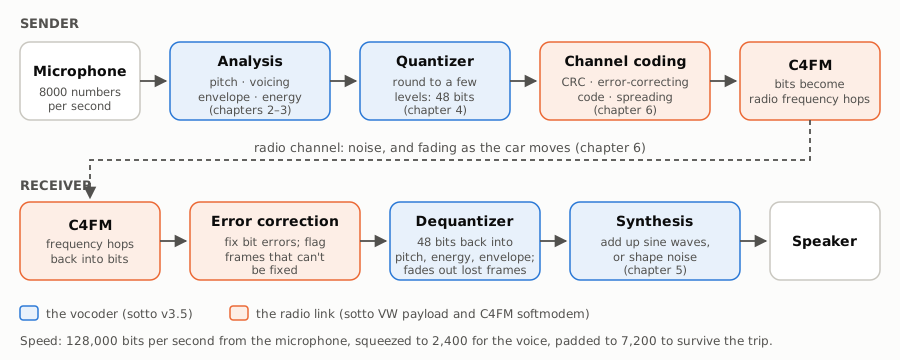
sotto is an open-source vocoder: a program that turns your voice into a tiny stream of numbers, small enough to send over a radio, and then turns those numbers back into a voice at the other end. This course explains every piece of it, one chapter at a time.
It is written for a high-school student (about 10th grade). You need:
- a little algebra (graphs, powers of 2),
- the idea of a sine wave (we review it),
- curiosity about how your phone or a ham radio can squeeze a voice into almost nothing.
Every picture in the course is drawn from real recordings and from the real sotto code. Nothing is a cartoon.
Chapters
- Sound, numbers and the 2,400-bit budget: what a vocoder is and why we need one.
- Pitch and voicing: the buzz of your vocal cords, and the hiss of an “s”.
- The spectral envelope: the shape of your mouth, and sotto’s 20-point mel envelope.
- Quantization: fitting it into 48 bits: rounding, steps, and the vector quantizer for the shape.
- Synthesis: rebuilding the voice: adding up sine waves, mixed voicing, and seven listening demos.
- Across the radio: C4FM, error-correcting codes, fading, spreading and hiding lost frames.
- How we measure “better”: PESQ, oracles, the quantization ladder and listening tests.
- The hiss band: s, sh and whispers: sotto v3.8’s 4,000 to 8,000 Hz hiss, the spare bits it hides in, and what the team learned building it.
- Glossary: every term used in the code and the design notes, in plain words.
Each chapter ends with Try it questions. Answers to the number questions are at the bottom of each chapter.
A note on what’s real
sotto is a research project and it is changing quickly. This course describes sotto v3.5 (October 2026), as described in docs/encoder-v0.md and docs/encoder-v1.md (which covers v1 through v3.5). sotto is a Python prototype built on Codec 2, an older open-source vocoder, and borrows its analysis and synthesizer. sotto’s own parts are a pitch and voicing tracker (chapter 2), mixed voicing (chapters 2 and 5), the 20-point envelope and its trained vector quantizer (chapters 3 and 4), and concealment of lost frames (chapter 6). It has been tested in simulation and by ear in a radio club’s listening rounds, not yet on the air.
Chapters 1 to 7 and their demos stay on v3.5. Since then: v3.6 shrank the codebook for the radio’s chip (chapter 4); v3.7 gave the pitch tracker one more candidate, a third of Codec 2’s estimate, which fixed some high-pitched pops; and v3.8 (November 2026) added the 4,000 to 8,000 Hz hiss band, which has its own chapter (chapter 8, from docs/unvoiced-hiss.md). All of them keep the same 48-bit, 20 ms frame. There is now also a C version of sotto, in floating point and in fixed point for the radio’s DSP chip (docs/c-port.md).
Rebuilding the figures
./tools/build_codec2.sh            # builds c2sim, c2enc, c2dec
make -C c                          # the v3.8 C tools, for chapter 8's figure and clips
python tools/course_figures.py     # rewrites docs/course/figures/*.svg and docs/course/audio/*.flac
The script reads the clips in docs/samples/ and the results in docs/results/. python tools/course_figures.py --hiss-only remakes just chapter 8’s figure and clips.